

Put the lashes down for a second and look at me. I see you heading to the floor with that “hopeful” look, and I already know what’s about to happen. You’re going to walk up to that guy in the corner booth- the one with the $40,000 watch and the “I own the city” posture- and you’re going to ask him, “Do you want a dance?”
Stop it. Right now. You are literally bleeding money before you even sit down.
When you ask for a “dance,” you are offering a commodity. You’re telling him you’re exactly the same as every other girl on the floor, and you’re giving him a 50/50 chance to say “no” and go back to his phone. We are not commodity traders, honey; we are High-Yield Asset Managers. You aren’t selling three minutes of movement to a generic beat; you’re selling a High-Limit Experience.
Today, we’re breaking down the Psychology of the Anchor. I’m going to show you how to set a price floor that scares off the brokies who are just here to waste your oxygen and attracts the whales who actually view you as a premium investment. We’re engineering a “No-Loss” negotiation strategy where you never, ever leave money on the table.
The Commodity Trap: Why “Do You Want a Dance?” is Killing Your Bag
When you use the “D-word,” you are entering a race to the bottom. In his head, a “dance” has a fixed price- usually whatever the club minimum is. If you start there, you’ve already capped your earnings. You’ve signaled that your time is worth the same as a burger and fries.
Whales don’t buy “dances.” They buy exclusivity. They buy the feeling that for the next hour, the most magnetic woman in the room is focused entirely on them. They buy the “Sovereign” vibe. If you want the big whale transfers, you have to stop speaking the language of the floor and start speaking the language of the vault. You aren’t an option; you are an Experience.

The Physics of the Anchor: Setting the Price Floor
In negotiation, the “Anchor” is the first number mentioned. It sets the mental boundary for the entire transaction. If you let him ask “How much?”, he’s going to anchor you low. If you mention a high-limit number first, his brain automatically recalibrates.
By dropping a high anchor, you do two things:
- The Filter: You immediately tell the “brokies” that they can’t afford your frequency. This saves your arches and your social battery.
- The Value Signal: You tell the Whale that you are rare. High-value men are conditioned to believe that “expensive equals better.” If you’re the most expensive girl in the room, his ego will want to be the one who can afford you.
Profiling the Room: Spotting Liquidity Before You Speak
You shouldn’t be dropping high-limit anchors on everyone. That’s a waste of energy. You need to be a professional profiler. You’re looking for signs of actual liquidity, not just “loud fakes” who are spending their rent money to look cool for an hour.
Before you even open your mouth, run this audit on your target:
- The Watch-to-Shoe Ratio: If he’s wearing a bright Rolex but his shoes are scuffed, mid-tier loafers, he’s over-leveraged. Real wealth is consistent from head to toe.
- The Drink Choice: Is he sipping a rail gin and tonic, or is there a bottle of something niche and aged on the table?
- The Interaction with Staff: Does he treat the busboys and security with quiet respect, or is he performing for the room? Real whales are usually Quiet Luxury, they don’t need to bark to be heard.
- The Phone Placement: If his phone is face down and he’s observing the room, he’s looking for an investment. If he’s scrolling, he’s bored and needs a Pattern Interrupt.
- The Body Language of the Group: If he’s the one everyone else is leaning toward when they speak, he’s the decision-maker. That’s your anchor point.
The “No-Loss” Script: Engineering the High-Limit Pitch
Now, here is the actual tactical deployment. Forget everything you learned in the “amateur” locker rooms. This is how you move a man from the floor to a multi-hour VIP lock-in without ever sounding like you’re begging for a buck.
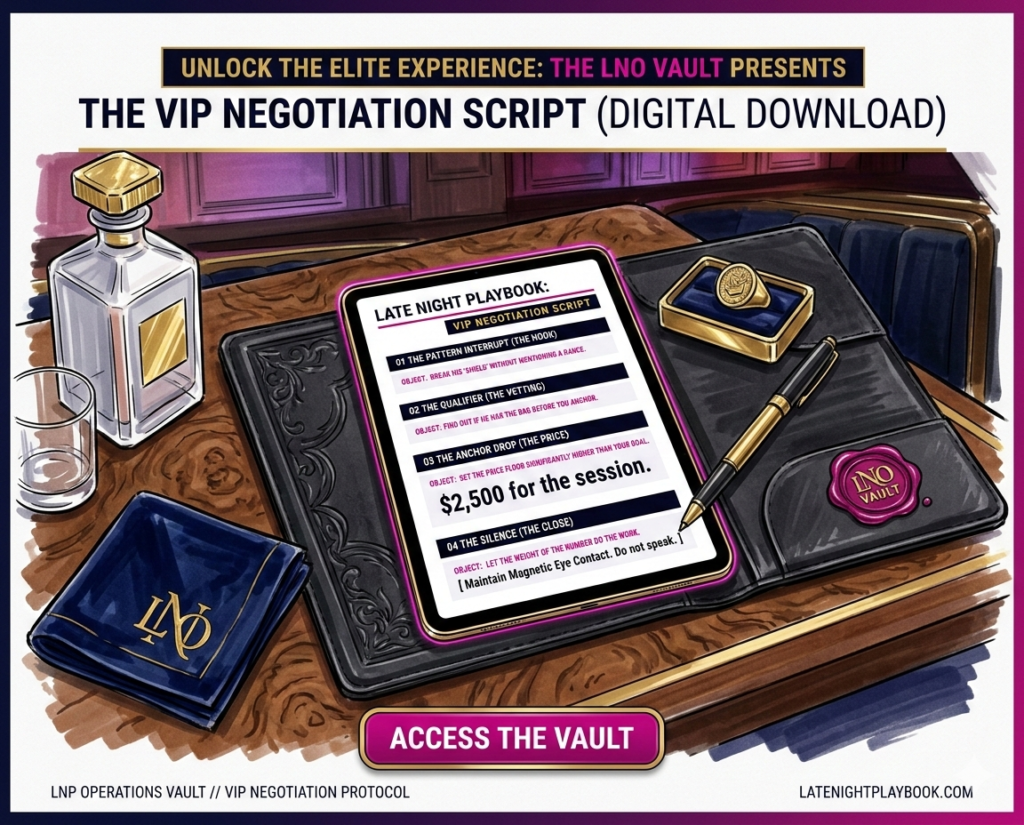
- The Pattern Interrupt: Walk up and don’t mention a dance. Mention his energy or something specific about his vibe. “You look like you’re having a much more interesting conversation with yourself than what’s happening on that stage.”
- The Value Proposition: Position yourself as a peer. “I’m actually heading to the back to decompress. I only do one or two long-form sessions a night because I prefer the privacy of the executive lounge over the noise out here.”
- The Anchor Drop: This is where you set the floor. “I’m doing a two-hour block in the Gold Room for $2,500. I have one slot left before I call it a night. I think our frequencies would actually align well for that.”
- The Silence: This is the most important step. After you drop the anchor, shut up. Do not apologize for the price. Do not explain it. The first person to speak after the anchor is dropped is the one who is uncomfortable. Let him sit in the weight of that number.
- The Recalibration (if needed): If he flinches, you don’t drop to $100. You offer a Discovery Tier. “If you aren’t ready for the full two-hour experience, we can do a 30-minute “Chemistry Check” in the VIP lounge for $600. It’ll give us a chance to see if the investment is worth it for you.”
The Sovereignty Mindset: Why You Never Leave Money on the Table
Babe, the “No-Loss” strategy means that even if he says “no,” you still win. Why? Because you’ve maintained your Visual and Verbal Authority.
If he says he can’t do $2,500, you don’t pout. You smile- a real smile- and say, “I completely understand. I respect a man who knows his limits. Enjoy your night, love.”
By walking away without devaluing yourself, you often trigger his Chase Instinct. I’ve had guys come find me two hours later, after they’ve had another drink and realized they’re bored with the “commodity” girls, and they’ll pay the anchor price just because I didn’t beg. You are the prize. You are the high-yield asset. When you negotiate properly, the money follows the energy.
Now, go touch up that matte lip, fix your crown, and go find a whale. The Gold Room is waiting for someone who knows how to close.